Credit: NASA · NASA material is generally not copyrighted; items carrying a third-party or copyright credit are excluded. The NASA logo and insignia are never reused.
NASA
APOD
Science
APOD
APOD: 2026 September 15 – A…
Today’s APOD
Archive
Submissions
Index
Search
Calendar
RSS
Education
About
Discuss
APOD
Astronomy Picture of the Day
Discover the cosmos! Each day a different image or photograph of our fascinating universe is featured, along with a brief explanation written by a professional astronomer.
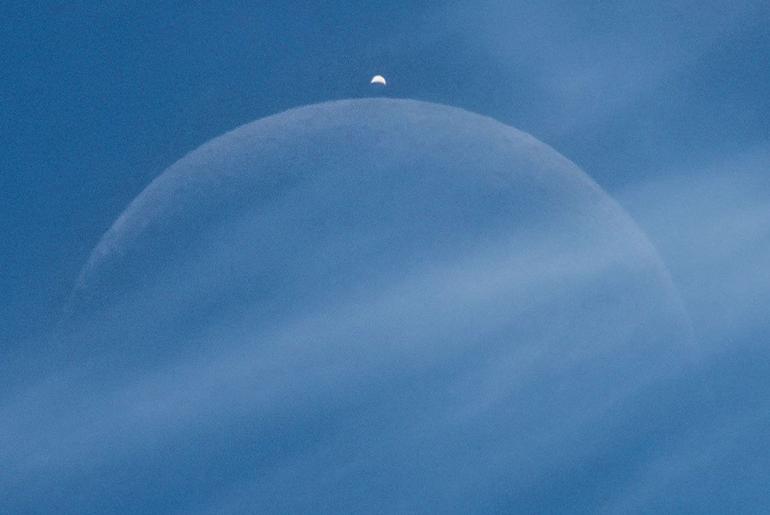
A Daytime Eclipse: Moon Occults Venus
There was something behind the clouds. Upon close inspection, it was the Moon, which was hard to see yesterday around noon above the small village of Cessy, France. But soon, it was not only the Moon. As expected, a bright dot suddenly appeared from behind the Moon — the planet Venus far in the distance. Captured in the single featured exposure, both appeared to show a crescent phase. The Moon’s crescent was quite slight — with only about 10 percent of its face illuminated by the Sun. In contrast, Venus’s crescent was more full — showing about 25 percent illumination. Venus appeared brighter because it is nearer the Sun and because its clouds are more reflective than the dark lunar surface. An occultation of Venus by the Moon is visible to only about 10 percent of the Earth, but in yesterday’s event even most of that was experiencing daytime.
APOD’s main NASA site is moving: From apod.nasa.gov to science.nasa.gov/apodTomorrow’s picture: galactic eye
Date
September 15, 2026
Credit & Copyright
Arnaud Mariat
Authors & editors:
Robert Nemiroff, Jerry Bonnell, Cecilia Chirenti, Keighley Rockcliffe
A service of:
ASD at NASA / GSFC,NASA Science Activation & Michigan Tech. U.
Random APOD Generator
Yesterday’s Image
APOD: 2026 September 14 – Where Your Elements Came From
Tomorrow’s Image