Written by Susanne P. Schwenzer, Professor of Planetary Mineralogy at The Open University, UK Earth planning date: Friday, Oct. 23, 2026 As regular readers…
Author not supplied
· Published 10 Nov 2026, 02:05 · Updated 10 Nov 2026, 02:05
Credit: NASA · NASA material is generally not copyrighted; items carrying a third-party or copyright credit are excluded. The NASA logo and insignia are never reused.
NASA
Curiosity Navigation
Curiosity Home
Mission Overview
Where is Curiosity?
Mission Updates
Science
Overview
Instruments
Highlights
Exploration Goals
News and Features
Multimedia
Curiosity Raw Images
Images
Videos
Audio
Mosaics
More Resources
Mars Missions
Mars Perseverance Rover
Mars Curiosity Rover
Mars Reconnaissance Orbiter
Mars Odyssey
More Mars Missions
Mars Home
3 min read
Curiosity Blog, Sols 5050-5055: It’s Nazca, Our 49th Drill Hole
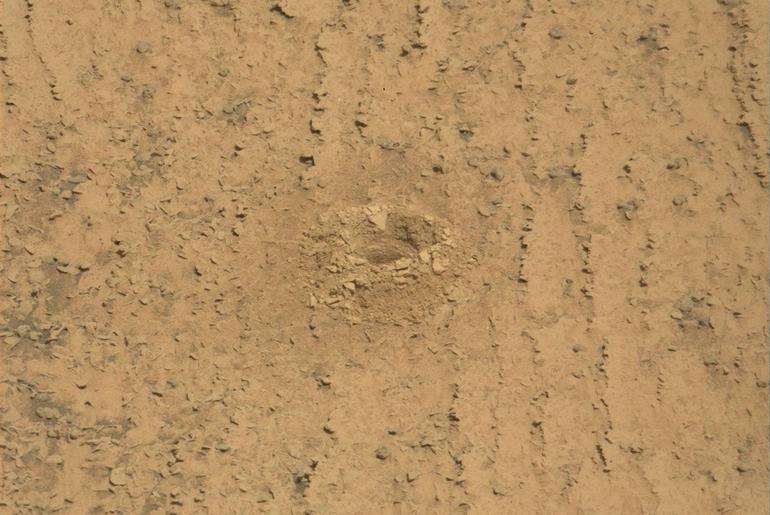
This image of the Nazca drill hole was taken by Mast Camera (Mastcam) onboard NASA’s Mars rover Curiosity on Sol 5050 (2026-10-20 23:56:20 UTC).
NASA/JPL-Caltech/MSSS
Written by Susanne P. Schwenzer, Professor of Planetary Mineralogy at The Open University, UK
Earth planning date: Friday, Oct. 23, 2026
As regular readers of this blog will know, we returned to the area where we found disc shaped inclusions in the rocks, which we interpreted as potential crystals. If they are indeed crystals, and we compare them to Earth, they could be very interesting indicators of the environmental conditions. Hence, the excitement in the team is high that we found a good block to drill. Good means first and foremost that it contains abundant potential crystals, but of course there is more before we drill. We passed the rover’s stability test, as all wheels have to be on solid ground before we extend the arm. Then we passed the preload test, which tests the stability of the rock and the forces the arm experiences when the drill bit presses into the rock.
With all those tests passed, we successfully drilled our 49th drill hole, called “Nazca.”
The drill campaign comes with many investigations before and after the drilling itself. Before the drill, we investigated the block with APXS, MAHLI and ChemCam – all on the target Nazca. After drilling, the sample was dropped off to CheMin, with the results still making their way from Mars to Earth. They are eagerly anticipated to reach us over the coming weekend. ChemCam obtained both passive spectral and active LIBS of the tailings and a LIBS measurement down the drill hole wall.
Other ChemCam activities this week included a LIBS investigation of “Palpala,” which is a dark pebble. We are on the lookout for those pebbles for a while and find that not all of them have the same composition. To make sure we understand their origin, we are measuring them when there are some in reach that are big enough. If a pebble is too small, it can move when it is being hit by the laser. Hence, we need to look out for some that are big enough.
Another such pebble was the target “Puna” identified in Friday’s planning. ChemCam LIBS on the target “Llama” is to get another depth profile to check whether our observations in the first such depth profile are consistently observed or whether they vary between locations.
The target “Pacaya” is another measurement of the disc shaped forms that drew us back to this region. In addition to the LIBS measurements, ChemCam has several long distance RMIs in the plan. They are all focused on the two buttes that have drawn a long-standing interest of the team for the various sedimentary structures and textures they reveal: Mishe Mokwa and Cordillera.
Want to read more posts from the Curiosity team?
Visit Mission Updates
Want to learn more about Curiosity’s science instruments?
Visit the Science Instruments page
NASA’s Curiosity rover at the base of Mount Sharp
NASA/JPL-Caltech/MSSS
Share
Details
Last Updated
Nov 09, 2026
Related Terms
Blogs
Explore More
3 min read
Curiosity Blog, Sols 5056-5062: Charging Back Up!
Article
32 minutes ago
2 min read
Rubies on Mars?
Article
3 hours ago
2 min read
Newest Sample, Oldest Rock?
Article
3 hours ago
Keep Exploring
Discover More Topics From NASA
Mars
Mars is the fourth planet from the Sun, and the seventh largest. It’s the only planet we know of inhabited…
All Mars Resources
Explore this collection of Mars images, videos, resources, PDFs, and toolkits. Discover valuable content designed to inform, educate, and inspire,…
Rover Basics
Each robotic explorer sent to the Red Planet has its own unique capabilities driven by science. Many attributes of a…
Mars Exploration: Science Goals
The key to understanding the past, present or future potential for life on Mars can be found in NASA’s four…