Ceasefire talks resume as negotiators arrive for a second round
Signal Bulletin report
Help Overlap Zoo Reveal Cosmic Dust
Galaxies, vast collections of billions of stars, gas, and dust held together by gravity, are scattered across the immensity of space. But every so often, a…
Author not supplied
· Published 30 Sep 2026, 22:07 · Updated 30 Sep 2026, 22:07
Credit: NASA · NASA material is generally not copyrighted; items carrying a third-party or copyright credit are excluded. The NASA logo and insignia are never reused.
NASA
Explore This Section
Science
Citizen Science
Help Overlap Zoo Reveal Cosmic…
Overview
Resources
Opportunities
Citizen Science
Highlights
About Science Activation
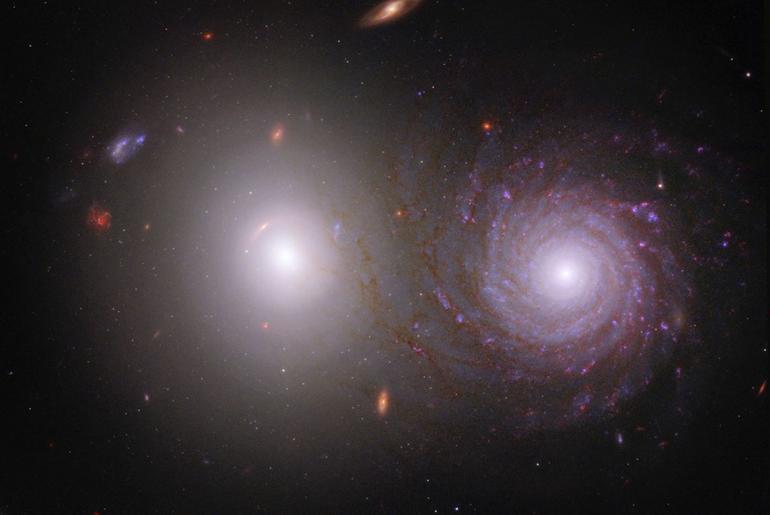
Galaxies, vast collections of billions of stars, gas, and dust held together by gravity, are scattered across the immensity of space. But every so often, a coincidence occurs: Two galaxies line up from our point of view on Earth (or from a space telescope) and appear to overlap in the sky. These rare overlapping galaxies give astronomers a chance to study something normally difficult to see: the dust inside one of these distant cosmic objects. That’s the focus of NASA’s new Overlap Zoo project.
Picture the background galaxy acting like a cosmic flashlight, shining through the nearer galaxy. The backlit dust creates dark silhouettes, like shadows on a screen. By studying these silhouettes, astronomers can map how dust is distributed throughout galaxies and learn how it blocks, scatters, and dims starlight traveling through space. Measurements of how dust impacts light can even help astronomers refine estimates of the distances to faraway objects.
However, before we can study galaxy pairs and their dust, we first need to find them! Overlap Zoo is asking for your help with the search.
“As new and better observations of galaxies continue to multiply, it is becoming incredibly difficult for astronomers to classify every candidate galaxy pair,” said Trevor Butrum, Overlap Zoo project lead and graduate student. “Your help is invaluable to creating the biggest and cleanest catalog of overlapping galaxy pairs for further analysis.”
As a volunteer in Overlap Zoo, you’ll view images that volunteers in the Galaxy Zoo project have identified as containing possible overlapping galaxies. The Overlap Zoo project will teach you how to verify the presence of galaxy pairs in these images, classify key features of each galaxy, and mark their outlines. You’ll learn as you go, classifying as many of these images as you like. Your contributions will help build the first large-scale catalog of galaxy pairs suitable for dust studies and enable a huge step forward in accuracy of astronomical estimates.
Head over to Overlap Zoo and start classifying galaxies today. No prior experience needed – just curiosity and a few minutes of your time. Your observations will help unlock the secrets hidden in these rare cosmic alignments!
A prime example of an overlapping galaxy pair known as VV191a/b.
Image credit: NASA, ESA, CSA, JWST PEARLS Team, Rogier Windhorst (ASU), William Keel (University of Alabama), Stuart Wyithe (University of Melbourne); Image Processing: Alyssa Pagan (STScI)
Learn More and Get Involved
Overlap Zoo
Confirm and describe overlapping galaxy pairs to reveal interstellar dust. For anyone with an internet-connected computer.
Facebook logo
@nasascience_
@nasascience_
Instagram logo
@nasascience_
Linkedin logo
@nasascience_