Ceasefire talks resume as negotiators arrive for a second round
Signal Bulletin report
NASA, International Partners Advance Work on Space Crops
NASA, CSA (Canadian Space Agency), and the German Aerospace Center signed a joint statement of intent to begin coordinated, preparatory work toward an…
Author not supplied
· Published 30 Sep 2026, 19:01 · Updated 30 Sep 2026, 19:01
Credit: NASA · NASA material is generally not copyrighted; items carrying a third-party or copyright credit are excluded. The NASA logo and insignia are never reused.
NASANASA, CSA (Canadian Space Agency), and the German Aerospace Center signed a joint statement of intent to begin coordinated, preparatory work toward an Earth-based demonstrator to learn how to grow crops on the Moon, which will be essential to helping astronauts go farther and stay longer in space.
The Lunar Agriculture Module-Ground Test Demonstrator aims to develop the technologies needed to grow space crops and study how they perform under atmospheres and controlled environments similar to those expected during missions at Moon Base. Through Moon Base, NASA and its partners will build the infrastructure to support an enduring human presence near the Moon’s South Pole, advancing science and technology while preparing for future human missions to Mars. Space crops will provide deep space crews with whole-food nutrition and increase dietary variety. They can also absorb carbon dioxide, produce oxygen, and recycle water. These capabilities will become increasingly important as human missions extend farther from our home planet.
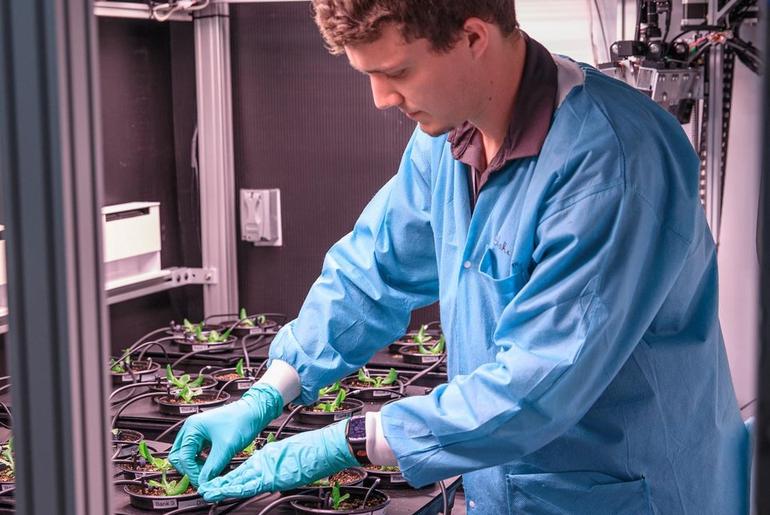
Horticulture scientist Blake Costine adjusts moisture sensors for the Advanced Plant Imaging project at NASA’s Kennedy Space Center on April 17, 2023. In this project, hyperspectral cameras are used to assess plant health. The activity is taking place inside the Plant Production Area at the Florida spaceport’s Space Station Processing Facility.
NASA/Isaac Watson
Download the PDF
LAM-GTD Joint Statement
Sep 30, 2026
PDF (501.13 KB)