Credit: NASA · NASA material is generally not copyrighted; items carrying a third-party or copyright credit are excluded. The NASA logo and insignia are never reused.
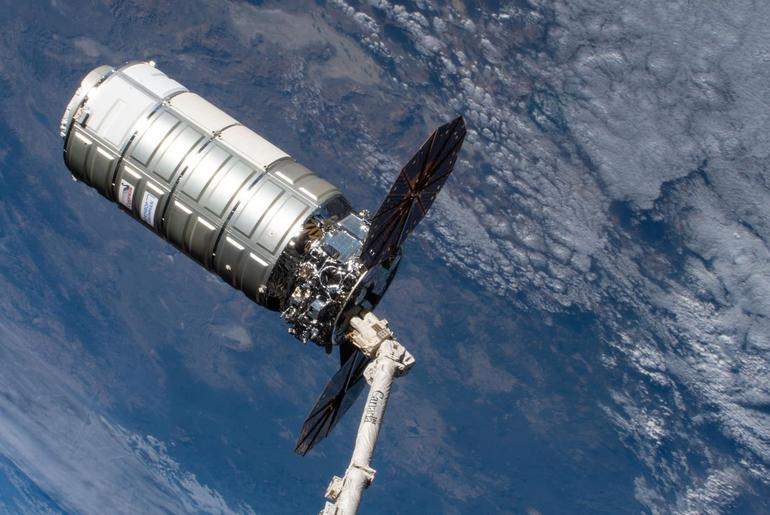
NASANorthrop Grumman’s Cygnus XL cargo spacecraft is pictured on Oct. 9, 2026, in the grip of the Canadarm2 robotic arm moments before its release into Earth orbit after a nearly six‑month stay attached to the International Space Station’s Unity module. The orbital outpost was soaring 263 miles above the Indian Ocean, off the coast of Madagascar, at the time of this photograph.Credit: NASA
Media accreditation is open for the next launch to deliver NASA science investigations, supplies, and equipment to the International Space Station. A Northrop Grumman Cygnus XL spacecraft will launch in November to the orbital laboratory on a SpaceX Falcon 9 rocket for NASA.
The mission is known as NASA’s Northrop Grumman Commercial Resupply Services 25, or NASA’s Northrop Grumman CRS-25. Liftoff is targeted for no earlier than 10:49 a.m. EST, Sunday, Nov. 29, from Space Launch Complex 40 at Cape Canaveral Space Force Station in Florida.
Following launch, astronauts aboard the space station will use the Canadarm2 robotic arm to capture Cygnus and install the spacecraft to the Unity module’s Earth-facing port for cargo unloading. The spacecraft will remain at the space station until May 2027. This is the company’s 25th spacecraft built to deliver supplies to the International Space Station under contract with NASA.
Credentialing to cover prelaunch and launch activities is open to U.S. media. The application deadline for U.S. citizens is 11:59 p.m. EST, Thursday, Nov. 12. All accreditation requests must be submitted online at:
https://media.ksc.nasa.gov
Credentialed media will receive a confirmation email following approval. NASA’s media accreditation policy is available online. For questions about accreditation, or to request special logistical support, email: ksc-media-accreditat@mail.nasa.gov. For other questions, please contact NASA’s Kennedy Space Center newsroom at: 321-867-2468.
In addition to food, supplies, and equipment for the crew, Cygnus will deliver several new experiments, including hardware to manufacture tiny, DNA-inspired particles in space that could improve drug delivery for cancer and osteoarthritis, as well as a study that could guide cancer treatments by predicting whether a patient’s cancer is likely to spread to other parts of the body. Cygnus also will carry human muscle cells and medications to test therapeutics for muscle loss associated with spaceflight and aging on Earth, and a compact radiation sensor designed to improve crew safety on future missions.
Each resupply mission to the station delivers scientific investigations in the areas of biology and biotechnology, Earth and space science, physical sciences, and technology development and demonstrations. Cargo resupply from U.S. companies ensures a national capability to deliver scientific research to the space station, increasing NASA’s ability to conduct new investigations aboard humanity’s laboratory in space.
For 26 years, people have lived and worked continuously aboard the International Space Station, advancing scientific knowledge and making research breakthroughs that are not possible on Earth. The space station is an important testbed for NASA to understand and overcome the challenges of long-duration spaceflight and to expand commercial opportunities in low Earth orbit. As commercial companies concentrate on providing human space transportation services and destinations as part of a strong low Earth orbit economy, NASA is focusing its resources on deep space missions to the Moon as part of the Artemis and Moon Base programs to build on our foundation for the first astronaut missions to Mars.
Learn more about International Space Station research and operations at:
https://www.nasa.gov/station
-end-
Josh Finch / Jimi RussellHeadquarters, Washington202-358-1100joshua.a.finch@nasa.gov / james.j.russell@nasa.gov
Steven SiceloffKennedy Space Center, Fla.321-876-2468steven.p.siceloff@nasa.gov
Sandra Jones / Leah CheshierJohnson Space Center, Houston281-483-5111sandra.p.jones@nasa.gov / leah.d.cheshier@nasa.gov
Share
Details
Last Updated
Nov 02, 2026
EditorJessica TaveauLocationNASA Headquarters
Related TermsCommercial SpaceCommercial ResupplyInternational Space Station (ISS)ISS ResearchJohnson Space CenterKennedy Space CenterNorthrop Grumman Commercial Resupply