Ceasefire talks resume as negotiators arrive for a second round
Signal Bulletin report
What’s Up: November 2026 Skywatching Tips from NASA
Meteor Showers, a Spacecraft Milestone, and a Supermoon Catch Taurid and Leonid meteors, spot Mars near Jupiter, celebrate Voyager 1’s light-day milestone…
Author not supplied
· Published 02 Nov 2026, 19:11 · Updated 02 Nov 2026, 19:11
Credit: NASA · NASA material is generally not copyrighted; items carrying a third-party or copyright credit are excluded. The NASA logo and insignia are never reused.
NASA
Skywatching
Skywatching Home
What’s Up
Meteor Showers
Eclipses
Daily Moon Guide
More
Tips & Guides
Skywatching FAQ
Night Sky Network
Meteor Showers, a Spacecraft Milestone, and a Supermoon
Catch Taurid and Leonid meteors, spot Mars near Jupiter, celebrate Voyager 1’s light-day milestone, and watch November’s supermoon.
Skywatching Highlights
Around Nov. 5: Southern Taurids peak; occasional bright fireballs
Around Nov. 12: Northern Taurids peak; around five meteors per hour under ideal conditions
Nov. 15-16: Mars and Jupiter appear 1.2 degrees apart before sunrise
Nov. 17: Shine Bright for Voyager’s Light-Day activation
Nov. 17-18: Leonids before dawn after moonset; up to around 15 meteors per hour under ideal conditions
Nov. 24: Full supermoon; first in a series of three consecutive supermoons
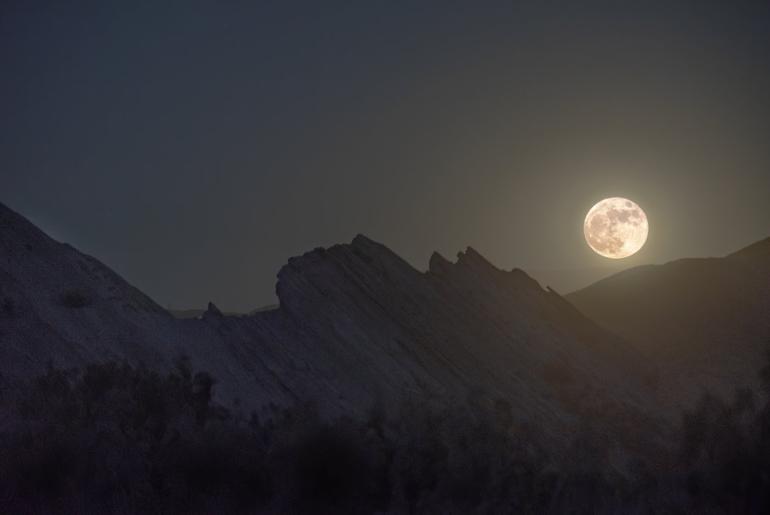
A full Moon rises over Vasquez Rocks Natural Area and Nature Center north of Los Angeles, California, on June 24, 2021.
Credit: NASA/Preston Dyches
Transcript
A month of meteor showers … a close pairing of Mars and Jupiter … and a supermoon!
That’s What’s Up for November.
November offers a buffet of opportunities to see a meteor streak across the sky!
The Southern Taurids peak around November 5th, followed by the Northern Taurids around November 12th.
Those names refer to the two areas in the constellation Taurus, where the meteors appear to originate.
Each Taurid shower produces only a handful of meteors per hour—around five, under ideal conditions—but an occasional bright fireball can make the wait worthwhile.
A sky chart showing where to look for the Leonids in November 2026.
NASA/JPL-Caltech
Next up are the Leonids. For the best viewing times, try the early morning hours of November 17th and 18th, after the Moon sets. Under ideal conditions, the shower could produce around 15 meteors per hour, though most viewers will see fewer.
To level up your viewing experience, you will want to find a dark location, give your eyes about half an hour to adjust, and take in as much sky as you can.
Around mid-month, there’s another reason to head outside early. On the mornings of November 15th and 16th, look southeast before sunrise to see Mars and Jupiter close together.
A sky chart showing Mars and Jupiter close in the night sky.
Credit: NASA/JPL-Caltech
They’ll appear about 1.2 degrees apart—a little more than the width of two full Moons side by side. Jupiter is the brighter point of light, with reddish Mars nearby.
Both planets are easy to see with the unaided eye. They’re still far apart in space, but from Earth, they appear almost side by side.
Watch over several mornings to see them draw closer together – and then go their separate ways.
Artist’s rendering of a NASA Voyager spacecraft traveling through interstellar space.
Credit: NASA/JPL-Caltech
This month, NASA’s Voyager 1 spacecraft will reach a historic milestone, becoming the first human-made object to travel one light-day from Earth.
That means a signal traveling at the speed of light takes 24 hours to reach the spacecraft – and another 24 hours for us to hear back from it!
If you want to imagine where Voyager 1 is currently traveling, look in the direction of the constellation Ophiuchus, the Serpent Bearer.
A night sky chart highlights the location of Voyager 1 within the constellation Ophiuchus on November 17 around 5 p.m., looking toward the western horizon.
Credit: NASA/JPL-Caltech
And on November 17th, join us in celebrating this milestone by participating in our Shine Bright for Voyager’s Light-Day activation. Learn more at nasa.gov/voyager.
On November 24th, the evening sky will be lit by a supermoon.
Because the Moon’s orbit is slightly oval, its distance from Earth changes. When it’s closer, the full Moon appears larger and brighter than average – though the difference can be subtle.
This kicks off a series of three consecutive supermoons in November, December, and January.
Look east around sunset to watch it rise. It may look even bigger near the horizon, but that’s the Moon illusion —a common effect with any full Moon.
Here are the phases of the Moon for November:
Moon phases for November 2026, showing the dates for Third Quarter, New Moon, First Quarter, Full “Supermoon,” and a concluding Third Quarter in Pacific Time.
Credit: NASA/JPL-Caltech
You can stay up to date on all of NASA’s missions exploring the solar system and beyond at NASA Science.
I’m Raquel Villanueva from NASA’s Jet Propulsion Laboratory and that’s What’s Up this month.
Learn More and Get Involved
Night Sky Network
The Night Sky Network is a nationwide coalition of amateur astronomy clubs bringing the science, technology, and inspiration of NASA’s missions to the general public.
NASA Skywatching Resources
Expert skywatching tips and more from our experts.
Share
Details
Last Updated
Nov 02, 2026
Related Terms
Skywatching
Earth’s Moon
Leonids
Skywatching Tips
The Solar System
Keep Exploring
Discover More Topics From NASA
What’s Up
Skywatching
Earth’s Moon
The Moon makes Earth more livable, sets the rhythm of ocean tides, and keeps a record of our solar system’s…
Meteor Showers