Ceasefire talks resume as negotiators arrive for a second round
Signal Bulletin report
NASA’s Curiosity Rover Catches Stunning Martian Dawn
A newly released panorama captured by NASA’s Curiosity rover offers the most detailed view yet of distant, wind-carved Martian cliffs, highlighting features…
Author not supplied
· Published 06 Oct 2026, 15:48 · Updated 06 Oct 2026, 15:48
Credit: NASA · NASA material is generally not copyrighted; items carrying a third-party or copyright credit are excluded. The NASA logo and insignia are never reused.
NASA3 min readPreparations for Next Moonwalk Simulations Underway (and Underwater)
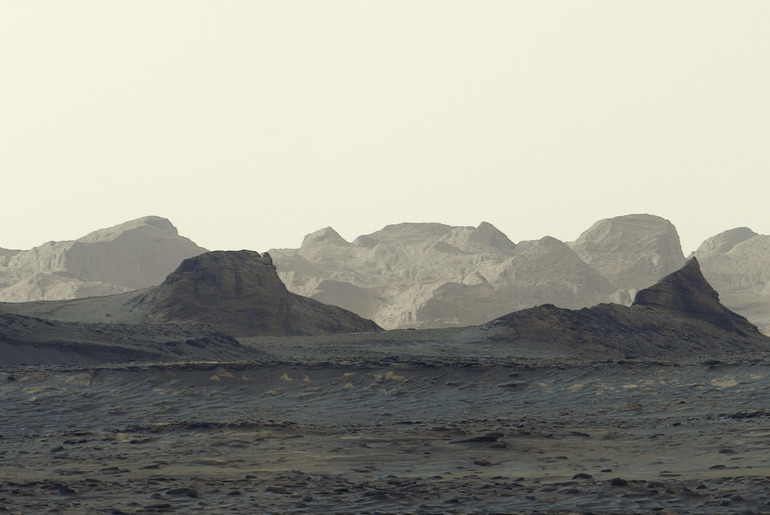
The captivating shapes of wind-carved crags called yardangs are revealed in this zoomed-in crop of a broader panorama captured by NASA’s Curiosity Mars rover on Aug. 11, 2026. Scientists are eager to learn more about how the yardang layer formed.NASA/JPL-Caltech/MSSS
A newly released panorama captured by NASA’s Curiosity rover offers the most detailed view yet of distant, wind-carved Martian cliffs, highlighting features the mission’s scientists have long been waiting to see up close. The scene was snapped at 8:30 a.m. local Mars time, showing striking blue hues in the foreground as bright morning light illuminates crags known as yardangs on the horizon.
The panorama was captured by Curiosity’s Mastcam on Aug. 11, the 4,982nd Martian day, or sol, of the mission, and comprises six individual images that were stitched together after being sent to Earth. Unlike most of Curiosity’s Mastcam images, this one was processed without white balancing, preserving the early morning appearance.
The six shots that make up this panorama, captured by NASA’s Curiosity on Aug. 11, were stitched together after being sent back to Earth. Unlike most images from the rover’s Mastcam, this one was processed without the usual white balancing — an artistic choice that preserves the early morning appearance.NASA/JPL-Caltech/MSSS
The yardang layer extends roughly 10 miles (16 kilometers) across the northwestern reaches of Mount Sharp, a 3-mile-tall (5-kilometer-tall) mountain that Curiosity has been ascending since 2014. In fact, the rover recently passed another milestone in its ascent, reaching 0.6 miles (1 kilometer) of elevation — the most ever climbed on Mars. As it draws ever-closer to the yardangs, mission scientists expect to get even more amazing imagery — and, they hope, answers to how these cliffs were created.
Mount Sharp is made up of layers, each recording a distinct period of Mars’ history. By studying them, scientists have been able to learn more about lakes and streams that covered this part of the Red Planet billions of years ago. Eventually, the water dried up and left salty minerals behind. After new material stopped settling on the mountain, some of it may have been stripped away by wind, giving rise to the yardangs.
This artist’s concept shows Mount Sharp, the 3-mile-tall (5-kilometer-tall) mountain that NASA’s Curiosity has been ascending since 2014. The location of the yardang layer, which the rover recently captured from a distance, is indicated by an ellipse annotation on the mountain’s northwestern shoulder.NASA/JPL-Caltech/ESA/DLR/FU Berlin/MSSS
NASA’s Curiosity Mars rover captured this view looking back at the floor of Gale Crater on Sept. 5, 2026. Just nine days prior, the rover had marked 1 kilometer of elevation gain above the crater floor since beginning its ascent of Mount Sharp in 2014.NASA/JPL-Caltech/MSSS
“The yardang layer looks out of place. It’s the wrong color, the layers tilt at an odd angle, and it almost appears plastered on,” said Ashwin Vasavada, Curiosity project scientist of NASA’s Jet Propulsion Laboratory in Southern California. “But that’s what makes it exciting to reach. No one is sure exactly what created this layer, but one idea is it may be ash deposited by ancient volcanic eruptions.”
Curiosity is in the second year of its fifth extended mission, which started with an exploration of the spiderweb-like boxwork ridges. The rover will spend most of the next year or so driving through layers enriched with sulfates and carbonates, both signs of ancient drying on the surface. Sometime in 2027, scientists hope to reach the base of the yardangs, where Curiosity will be able to use its robotic arm to collect one-of-a-kind data on these mysterious features.
More about Curiosity
Curiosity was built by NASA JPL, which is managed by Caltech in Pasadena, California. NASA JPL leads the mission on behalf of the agency’s Science Mission Directorate in Washington as part of its Mars Exploration Program portfolio. Malin Space Science Systems in San Diego built and operates Mastcam.
To learn more about Curiosity, visit:
https://science.nasa.gov/mission/msl-curiosity
News Media Contacts
Andrew GoodJet Propulsion Laboratory, Pasadena, Calif.818-393-2433andrew.c.good@jpl.nasa.gov
Karen Fox / Alana JohnsonNASA Headquarters, Washington240-285-5155 / 202-672-4780karen.c.fox@nasa.gov / alana.r.johnson@nasa.gov
2026-067
Share
Details
Last Updated
Oct 06, 2026
Related TermsCuriosity (Rover)Jet Propulsion LaboratoryMarsMars Science Laboratory (MSL)Planetary Science
Explore More
5 min read
US-India Satellite Captures Time-lapse Video of Volcanic Eruption
Article
2 weeks ago
6 min read
NASA-Funded Research Finds Complex Life Defying Record Heat
Lee esta historia en español aquí. NASA-supported scientists have discovered an organism that lives at…
Article
2 weeks ago
5 min read
NASA Discovery Reveals Complex Water Systems on Early Mars
Article
2 weeks ago
Keep Exploring
Discover Related Topics
Mars Science Laboratory: Curiosity Rover
Part of NASA’s Mars Science Laboratory mission, at the time of launch, Curiosity was the largest and most capable rover…
Curiosity Science Highlights
Curiosity Finds Evidence of Persistent Liquid Water in the Past Just after landing, Curiosity found smooth, rounded pebbles that likely…
Mars Exploration
Mars is the only planet we know of inhabited entirely by robots. Learn more about the Mars Missions.
Planetary Science
NASA’s planetary science program explores the objects in our solar system to better understand its history and the distribution of…